

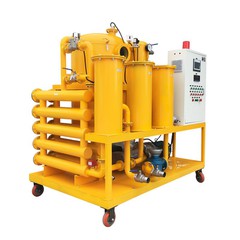

Lubricating oil plays a crucial role in mechanical equipment. It not only reduces friction and wear between parts but also carries away heat and prevents corrosion. However, over long-term use, lubricating oil can accumulate impurities such as metal shavings, dust, and moisture, affecting its performance and ultimately harming the equipment. This is where lubricating oil purifiers become essential.
The working principle of a lubricating oil purifiers is primarily based on filtration and separation technologies. For filtration, it employs two methods: mechanical filtration and adsorption filtration. Mechanical filtration uses filter screens of different pore sizes to intercept solid impurities. These screens include metal mesh and fiber mesh; the former is suitable for intercepting larger particles, while the latter can achieve micron-level filtration precision. Adsorption filtration utilizes materials such as activated carbon and silica gel to adsorb impurities and harmful components. For example, activated carbon can adsorb pigments, odors, and some organic matter, while silica gel has a strong adsorption capacity for moisture.
For separation, lubricating oil purifiers employ three technologies: gravity separation, centrifugal separation, and vacuum separation. Gravity separation utilizes the difference in density between different substances to separate oil, water, and impurities under static or slow-flowing conditions. Centrifugal separation uses a high-speed rotating centrifugal force field to separate different components in lubricating oil based on their density and mass differences. Vacuum separation utilizes the principle of lower boiling point of liquids in a vacuum environment; the lubricating oil is heated and introduced into a vacuum tank, causing water and light volatiles to vaporize and be extracted.
The functions of a lubricating oil purifiers are mainly reflected in four aspects: First, it extends the service life of lubricating oil by removing impurities and water, reducing damage to the chemical properties of the lubricating oil. Second, it protects mechanical equipment by ensuring the cleanliness of the lubricating oil entering the equipment, reducing wear, and improving equipment reliability and stability. Third, it improves equipment operating efficiency by enhancing the fluidity and heat dissipation performance of the lubricating oil. Fourth, it reduces environmental pollution by reducing the amount of waste lubricating oil generated, meeting environmental protection requirements.
Whether in large-scale machinery in industrial production or vehicle engines in the transportation sector, lubricating oil purifiers play a crucial role, providing strong support for the stable operation and long-term use of equipment.