

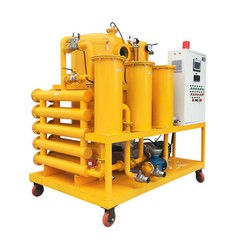
If you’ve ever spent time in a heavy industrial facility—think a manufacturing plant, a mining operation, or a marine engine room—you’ve likely seen a large, quiet machine humming away in a corner, pulling grimy, sludge-covered lubricating oil and turning it back into a clear, usable fluid. That machine is often a gravity-based lubricating oil purifier, and it’s one of the most underrated workhorses of equipment maintenance. As a supplier of industrial oil treatment solutions, I get asked all the time: How does this simple-sounding device actually work? It’s not just a fancy filter—it’s a precise piece of engineering that leans on a fundamental force we all learned about in middle school science: gravity.
Let’s start with the problem every industrial operator faces: lubricating oil doesn’t stay clean forever. Over time, as it circulates through engines, gearboxes, or hydraulic systems, it picks up contaminants. These aren’t just bits of dirt—they’re tiny metal shavings from engine wear, water that seeps in through condensation or leaks, sludge from oxidized oil, and even air bubbles that cause foam. Left untreated, these contaminants eat away at equipment parts, reduce efficiency, and lead to costly breakdowns. Most standard filters catch only large particles, but gravity-based purifiers target the smaller, trickier contaminants that slip through, which is why they’re so critical.
The core principle behind these purifiers is density separation: all fluids and solid contaminants have different densities, so under the right conditions, they will separate on their own when left undisturbed. Gravity, acting over time, pulls denser substances downward, while less dense substances stay afloat. But here’s the thing—good gravity-based purifiers don’t just leave oil sitting in a bucket. They optimize that separation by controlling temperature, flow rate, and the physical structure of the machine to make the process fast, efficient, and scalable for large industrial volumes.
Let’s walk through how a typical gravity-based lubricating oil purifier operates step by step. First, dirty oil is drawn from the equipment—say, from a large diesel engine’s sump or a gearbox reservoir—using a feed pump. The pump’s job is to move the oil at a consistent, moderate rate; push it too fast, and you’ll disrupt the natural separation, like stirring a glass of water with sand and expecting it to settle. From there, the oil is heated gently in a heat exchanger, usually to between 120 and 180 degrees Fahrenheit. Heating does two key things: it lowers the viscosity (thickness) of the oil, letting contaminants move more freely, and it separates water, which has a much lower boiling point than oil. Water, in particular, is the enemy of lubricating oil—it causes corrosion and breaks down the oil’s molecular structure—and gravity purifiers excel at removing it because water is denser than oil, so it sinks to the bottom.
Next, the oil flows into a large separation chamber, the heart of the purifier. This chamber is designed to be quiet and low-turbulence, so there’s no force messing with gravity’s work. Here, three main layers start to form, just like when you pour salad dressing and let it sit: at the very top is the least dense substance—usually air and foam—then the clean, lubricating oil in the middle, and at the very bottom, the denser contaminants: water, metal sludge, and fine particles. The separation time depends on the volume of oil and the size of the chamber; for a 500-gallon batch, it might take 4 to 8 hours, but modern models optimize this with gentle flow baffles that slow the oil’s movement without stopping it entirely, so you don’t have to shut down your whole process for days.
Wait a second—what about centrifugal purifiers? I get this question all the time from customers who confuse gravity-based systems with the fast-spinning ones you might see in auto shops. The key difference is that gravity-based purifiers use only natural gravity, no spinning, which makes them quieter, more energy-efficient, and better for large volumes of oil because they can process more at once without wearing out moving parts. Centrifugal systems are great for tight spaces, but gravity purifiers are the workhorses for industrial facilities that need to process hundreds or thousands of gallons of oil at a time, like mining operations or power plants.
Now, not all gravity purifiers are the same. As someone who’s helped hundreds of customers pick the right equipment, I always tell them to look for models that add small, targeted enhancements to the basic gravity principle, because that’s where the real efficiency comes in. For example, many modern models include coalescing filters before the separation chamber. Coalescing works because water droplets in dirty oil are tiny, often just microns wide—too small for gravity to pull down quickly. A coalescing media (usually a woven fiber that attracts water) makes those tiny droplets stick together, growing into larger, heavier drops that sink much faster. It’s like adding a magnet to help sand settle in water, only it’s designed for oil and water.
Another feature to look for is a drainage system that automatically removes the separated contaminants without wasting clean oil. Once the water and sludge settle to the bottom of the chamber, a level sensor detects the interface between oil and the denser layer, and opens a valve to drain only the waste. That means you don’t have to manually check and dump the chamber every few hours, which saves labor and prevents spills.
Let’s talk about real-world results. A few years ago, I worked with a mining operation in Western Australia that was going through 1,200 gallons of lubricating oil a month for their haul truck engines. They were using a cheap filter that only caught large dirt particles, and they had to replace a $20,000 engine part every six months because of water and fine metal sludge. We installed a gravity-based purifier, specifically the TYA-A automatic oil purifier, which uses temperature control and coalescing technology to remove 99% of free water and 85% of fine particles under 10 microns. Six months later, they were only using 200 gallons of new oil a month, had cut engine part replacements to once every two years, and saved over $180,000 in the first year alone. That’s the power of a gravity-based system—working with physics to make expensive oil last longer, and keep equipment running longer.
Of course, gravity-based purifiers aren’t just for heavy equipment. They’re also widely used for hydraulic systems, which rely on lubricating oil to transfer power. Hydraulic oil gets contaminated with air and dirt that can cause valves to stick, leading to costly downtime. An Oil Treatment Equipment unit that uses gravity separation can keep hydraulic oil clean for years, even in 24/7 manufacturing facilities. I’ve had customers in the food and beverage industry, which has strict rules about fluid cleanliness, use these purifiers to recycle oil for conveyor systems, reducing waste and meeting regulatory standards without breaking the bank.


Now, let’s address a common myth: some people think that gravity purifiers can’t handle used oil that’s really thick or contaminated. But that’s not true—it’s just about matching the right model to the job. For customers who have large volumes of heavily used oil, like from a fleet of commercial trucks or marine vessels, a Used Oil Filtration Machine with vacuum-assisted gravity separation can handle even the sludge that’s been sitting in a tank for months. The vacuum lowers the boiling point of water, making it easier to separate, while gravity pulls the dense contaminants down, so you don’t have to send that oil off to a reclamation plant for a much higher cost.
One of the biggest advantages of gravity-based purifiers over other types is their low maintenance. Because they don’t have spinning parts or high-pressure filters that need constant replacing, they have far fewer things to go wrong. I’ve had customers use the same gravity purifier for 10 years with only annual maintenance checks, while centrifugal purifiers in the same facility needed new bearings every two years. That makes them a smart long-term investment, not just a quick fix.
But no matter how well the gravity principle works, the key to getting the most out of your purifier is proper operation. You can’t just run a batch of dirty oil and expect it to be perfect—you have to maintain the right temperature, control the flow rate, and regularly check the interface between oil and waste in the separation chamber. That’s why we design our purifiers to be user-friendly, even for teams that don’t have a lot of technical experience. Our team works with every customer to train their staff on how to operate and maintain the machine, so they get the maximum performance out of it.
As someone in this industry, I’ve seen first-hand how a good gravity-based lubricating oil purifier can change a business. It’s not just about cleaning oil—it’s about reducing costs, extending equipment life, and minimizing environmental impact. When you recycle lubricating oil, you’re not buying new crude oil to refine into oil, which cuts down on carbon emissions and waste sent to landfills. A Used Oil Purification Plant from our line can process thousands of gallons of oil a month, turning what would be waste into a reusable product, which is a win for both your bottom line and the planet.
If you’re still wondering whether a gravity-based purifier is right for your operation, here’s a quick checklist: how much oil do you process monthly? What types of contaminants are you dealing with (water, sludge, fine particles)? How important is low maintenance and energy efficiency? For most industrial operations, the answer will point to a gravity-based system. It’s proven, cost-effective, and works with a principle that’s been around for centuries—we just refined it for modern industrial needs.
At the end of the day, the principle is simple: use density and gravity to separate what’s worth keeping from what’s not. But executing that principle well takes engineering, experience, and a focus on what customers actually need. That’s why we’ve spent years refining our Lubricating Oil Treat Machine line, making sure every part of the process—from the feed pump to the separation chamber to the automatic drainage—works to maximize separation without wasting time or oil.
If you’re ready to stop buying new lubricating oil for every piece of equipment, or tired of paying for frequent equipment repairs caused by contaminated oil, let’s talk. We can help you assess your specific needs, recommend the right gravity-based purifier, and make sure it fits seamlessly into your existing operation. Don’t let dirty oil keep your facility from running at peak efficiency—reach out today to learn how we can help you save money and keep your equipment running longer.
References
- Shigley, J. E., & Mischke, C. R. (2001). Standard Handbook of Machine Design. McGraw-Hill Education.
- Fink, J. K., & Lehmann, L. (2019). Petroleum Product Handbook. Gulf Professional Publishing.
- American Petroleum Institute. (2020). Recommended Practice for Lubricating Oil Conditioning and Monitoring. API Publishing Services.