

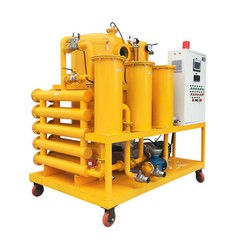

Plate and frame press oil filtration is a classic, time-proven method for industrial oil maintenance. As a cost-effective pressure-driven purification solution, it excels at removing solid contaminants and free water from various industrial oils. For facilities that need reliable basic oil cleaning without complex vacuum systems, the PL Series Plate Pressure Oil Purifier from Chongqing Top Oil Purifier Co., Ltd offers a simple, durable and low-operating-cost option.

→ PL series plate pressure oil purifier
How Plate and Frame Oil Filters Work
The working principle is straightforward. The machine consists of three core parts: a filter bed assembly, an oil feed pump, and a coarse inlet strainer.
Stacked filter plates and filter frames are clamped tightly by a manual pressing device, forming independent filtration chambers between each pair of plates. Filter paper or filter cloth is installed as the filtration medium inside each chamber. When the pump pushes contaminated oil into the system, oil flows through the filter media under pressure. Solid particles and sludge are trapped by the filter paper, while small amounts of free water are adsorbed. Clean oil then flows out from the outlet.
This simple mechanical structure makes the unit easy to operate and maintain on site, with no complex electronic controls required for basic models.

Applications and Compatible Oil Types
Designed for wide industrial use, PL series plate pressure oil purifiers serve power stations, power plants, industrial and mining enterprises, lubricant warehouses, tractor stations, petroleum and chemical facilities, metallurgy plants and national defense units.
It is suitable for filtering water and solid impurities from a broad range of oils:
Transformer oil and turbine oil
Engine oil, diesel oil and kerosene
Aviation hydraulic oil and other industrial lubricants
For edible oil filtration applications, food-grade stainless steel construction is available to meet hygiene and corrosion resistance requirements.

Core Structure of PL Series Units
1. Filter Bed Assembly
This is the core filtration section. Each unit is equipped with polypropylene filter plates and matching frames. The number of filter chambers and plates increases with larger model sizes, providing larger filtration area for higher flow capacity. All PL series models use manual pressure adjustment to secure the filter stack, which is reliable and easy to operate without auxiliary power.
2. Oil Feed Pump
A gear pump provides stable filtration pressure and consistent flow. Pump capacity is matched to each model's flow rating to ensure steady operation.
3. Coarse Inlet Strainer
Installed upstream of the filter bed, this pre-filter captures large, abrasive debris. It protects the pump from damage and extends the service life of the fine filter paper inside the filter bed.

Key Technical Specifications
The PL series covers a wide range of capacities to fit different operation scales:
- Flow rate range: 30 L/min to 300 L/min
- Working pressure: 0 – 0.5 MPa
- Filtration area: 0.3 m² to 3.1 m², scaled to model size
- Pressure adjustment: Manual operation for all models
- Standard power supply: 380V / 3P / 50Hz, customizable to match local grid requirements
- Motor power: 1.1 kW to 7.5 kW, matched to flow capacity

How to Select the Right Model
Choosing the correct plate and frame oil filter depends on your actual working conditions:
1. Required processing capacity
Calculate the total oil volume you need to process per shift, and select a model with matching flow rate. Larger filtration area also means longer filter paper service life for heavily contaminated oil.
2. Oil properties
For oils with high viscosity or low working temperature, consider models with higher pump power, or add an auxiliary heating unit to maintain smooth flow.
3. Oil contamination level
Oils with high sludge and solid content will load filter paper faster. Choosing a model with larger filtration area reduces frequent paper replacement and improves overall efficiency.
4. Material requirements
For corrosive oils or edible oil applications, confirm filter plate and wetted part material requirements before ordering.
Consumables and Supporting Oil Testing Equipment
Filter paper (or filter cloth) is the main consumable for this equipment. To keep operations running smoothly, it is recommended to stock sufficient spare filter media in matching sizes.
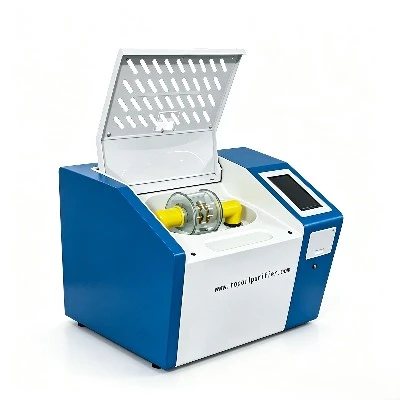
For complete oil maintenance management, the units can be paired with professional oil testing instruments to monitor oil condition before and after filtration. Common supporting testers include:
- Karl Fischer water content tester
- Kinematic viscosity tester
- Oil acidity tester
- Open/closed cup flash point tester
- Particle counter

Advantages and Practical Limitations
Advantages
- Simple structure and straightforward operation, requiring little operator training
- Low initial purchase cost and low daily operating expense
- Flexible on-site use, suitable for both workshop and oil depot scenarios
- Easy disassembly for cleaning and filter media replacement
Limitations
This equipment is designed for basic solid removal and free water adsorption. It cannot effectively remove dissolved water or dissolved gases from oil. For applications requiring deep dehydration and degassing - such as high-voltage transformer oil maintenance - a vacuum oil purifier is a more appropriate solution.
In practice, many facilities use plate and frame filters for daily coarse filtration, and vacuum purifiers for periodic deep treatment, to balance cost and purification performance.


Closing Thoughts
The PL series plate and frame press oil purifier is a reliable, budget-friendly choice for routine industrial oil cleaning. Its proven design delivers consistent solid removal performance across a wide range of oil types and industrial scenarios.
If you need help selecting the right PL model for your oil type and flow requirements, or want to learn about matching oil testing equipment, the technical team at Chongqing Top Oil Purifier Co., Ltd can provide professional guidance and customized configuration options.
→ PL series plate and frame press oil purifier
F A Q
What oils are PL series plate and frame oil filters suitable for?
+
-
A: They fit transformer oil, turbine oil, engine oil, diesel, lubricating oil and other industrial oils. Stainless steel models are available for edible oil filtration.
How do I select the right plate and frame oil filter model?
+
-
A: Choose based on required flow rate, oil contamination level, viscosity and material requirements. The PL series covers 30–300 L/min flow rates.
What is the main consumable, and how often does it need replacement?
+
-
A: Filter paper / filter cloth is the main consumable. Replacement cycle depends on oil contamination level - heavier sludge means more frequent changes.
What is the difference between a plate and frame filter and a vacuum oil purifier?
+
-
A: Plate and frame filters remove solid particles and free water at low cost. Vacuum oil purifiers deliver deeper removal of dissolved water and gases for higher purification accuracy.
For detailed product quotations or technical solutions, please contact us through the following:
📞 Contact Information
Abby Xiao
Mobile / WeChat: +86 13983391036
Email: sales@topoilpurifier.com
Website: www.topoilpurifier.com; www.toptester.com.cn
Manufacturer: Chongqing TOP Oil Purifier Co., Ltd.
Address: No. 1, Jianlong N. Rd., Jiulongpo District, Chongqing, China