


To manage lubricating oil effectively, it helps to look at four frameworks: where it is used, why it degrades, how it can be purified, and which equipment fits different scenarios.
1. Where Lubricating Oil Is Used
Lubricating oil is used far beyond simple friction reduction.
In industry, it is the base medium for hydraulic systems, gearboxes, compressors, pumps, machine tools, and many other pieces of industrial equipment. It performs several functions at the same time: lubrication, cooling, power transmission, rust prevention, and cleaning.
In food processing and general manufacturing, food-grade lubricating oils are used where incidental contact may occur. In daily life, lubricating oil is also used for furniture care, door hinges, and stuck zippers.
In short, lubricating oil is both an industrial consumable and a key factor in equipment reliability.

2. Why Lubricating Oil Degrades Early
Lubricating oil usually fails gradually, not suddenly. Three types of contamination are responsible for most problems.
Particle contamination
Metal wear debris, dust, carbon fines, and sludge can increase wear, clog filters, and reduce lubrication efficiency. In precision systems, even small particles can cause significant damage.
Water contamination
Water can exist as free water, dissolved water, or emulsified water. Free water may settle, but dissolved and emulsified water are much harder to remove by gravity alone. Water promotes corrosion, accelerates oxidation, and can cause oil emulsification.
Oxidation
Heat and oxygen cause lubricating oil to oxidize over time. This leads to higher acid value, darker color, varnish, sludge, and gum deposits. In severe cases, the oil loses its lubricating ability and may corrode equipment.
The goal of lubricating oil maintenance is not simply to change oil more often. It is to control contamination and extend oil service life.
3. How to Purify Lubricating Oil: Match Process to Problem
Different contamination problems require different purification methods.
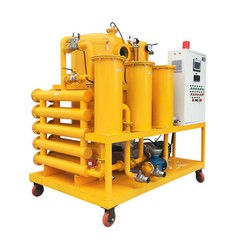
- Vacuum dehydration and degasification removes dissolved water, free water, and gases. It is widely used for hydraulic oil, gear oil, compressor oil, and other industrial lubricating oils.
- Centrifugal separation uses high-speed centrifugal force to separate free water and large particles. It is suitable for high-load environments where large volumes of lubricating oil must be cleaned continuously.
- Plate-and-frame pressure filtration is effective for retaining solid impurities in high-viscosity lubricating oil. It is often used for waste oil pretreatment or deep filtration.
- Regeneration and decolorization helps remove acidity, sludge, and discoloration products from used lubricating oil.
- Portable filtration is convenient for oil filling, oil transfer, and simple on-site filtration.
- Independent vacuum support can be added when the existing system cannot reach the required vacuum level quickly enough.
When selecting equipment, consider the lubricating oil type, contamination type, target cleanliness, flow rate, working conditions, and automation requirements.
4. Equipment Selection by Scenario: Recommended List
Based on Chongqing TOP's product line, the following solutions are recommended for lubricating oil applications.
Industrial lubricating oil - hydraulic oil, gear oil, compressor oil, refrigeration oil, etc.
Recommended:
TYA-A Fully Automatic Lubricating Oil Purifier
TYA-W Enclosed Lubricating Oil Purifier
TYA-Ex Explosion-Proof Lubricating Oil Purifier
Lubricating oil with high water content
Recommended: TYD High Water Content Oil Purifier.
Lubricating oil decolorization and purification
Recommended: TYR Oil Purification and Decoloration Machine.
Portable or on-site filtration
Recommended: JL Portable Oil Filter Machine.
Independent vacuum source for lubricating oil treatment
Recommended: ZKCC Vacuum Pump System.
Conclusion
The key to lubricating oil management is not frequent oil replacement. It is contamination control, extended oil life, and reduced downtime risk. By identifying the contamination type first and then choosing the right purification process, companies can get more value from every liter of lubricating oil.
Chongqing TOP Oil Purifier Co., Ltd. provides a complete range of lubricating oil purification solutions, from vacuum dehydration and portable filtration to decolorization and independent vacuum support. For product quotations or selection advice, please contact us.
📞 Contact Information
Abby Xiao
Mobile / WeChat: +86 13983391036
Email: sales@topoilpurifier.com
Website: www.topoilpurifier.com; www.toptester.com.cn
Manufacturer: Chongqing TOP Oil Purifier Co., Ltd.
Address: No. 1, Jianlong N. Rd., Jiulongpo District, Chongqing, China